


Vitamin D Guide: How Much You Need, Best Sources and Safe Supplement Use
This vitamin D guide explains a nutrient that helps your body absorb calcium and keeps bones and muscles strong. Many adults do not get enough from food alone. Here is how much you need, where to get it and how to supplement without taking too much.
Health note: This article is for general education only. It is not medical advice and it does not replace care from your doctor. Foods and supplements are not a substitute for prescribed treatment. Talk to a licensed health professional before changing your diet, medicines or supplements, especially if you are pregnant, take prescription drugs or have a chronic condition.
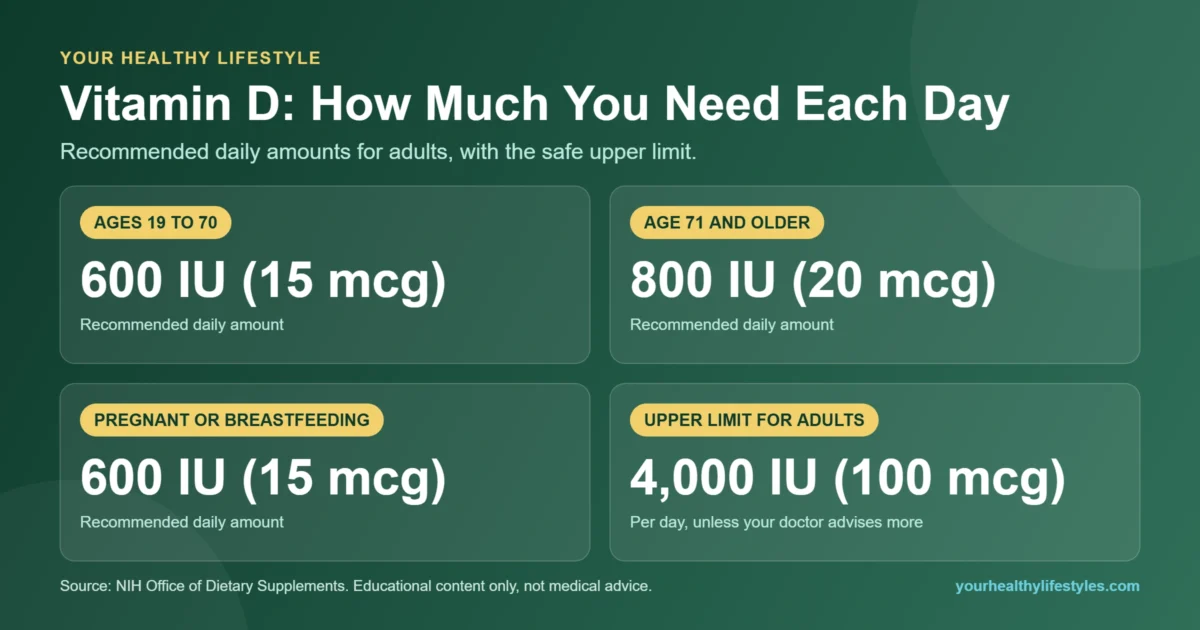
- Adults 19 to 70 need 600 IU (15 mcg) a day; adults over 70 need 800 IU (20 mcg).
- The safe upper limit for adults is 4,000 IU (100 mcg) a day unless your doctor advises more.
- More is not better. Very high doses can raise calcium to dangerous levels.
Vitamin D guide: how much you need
| Age | Recommended daily amount | Upper limit |
|---|---|---|
| 19 to 70 years | 600 IU (15 mcg) | 4,000 IU (100 mcg) |
| 71 years and older | 800 IU (20 mcg) | 4,000 IU (100 mcg) |
| Pregnant or breastfeeding | 600 IU (15 mcg) | 4,000 IU (100 mcg) |
Source: NIH Office of Dietary Supplements.
What vitamin D does
Stronger evidence
Vitamin D helps your body absorb calcium, one of the main building blocks of bone. Together with calcium, it helps protect against osteoporosis. It also supports the muscles you need for balance, which helps prevent falls. Exercise matters here too: see our guide to strength training for older adults. According to the NIH, supplements slightly increase bone strength in older adults. Research on vitamin D and other conditions, such as heart disease, cancer and memory, has produced mixed results.
Best food sources
Few foods naturally contain much vitamin D. These help the most.
- Fatty fish such as salmon, trout, mackerel and tuna
- Fortified milk (about 120 IU per cup) and fortified plant milks
- Fortified cereals and orange juice
- Egg yolks and beef liver (small amounts)
- Mushrooms exposed to UV light

Sunlight: helpful, with limits
Your skin makes vitamin D in sunlight. How much depends on the season, time of day, where you live, skin tone and age. In winter, people in northern US states make very little. Because UV exposure raises skin cancer risk, experts do not recommend relying on tanning or long sun exposure for vitamin D. Short, sensible sun time plus food and, if needed, a supplement is a balanced approach.
Who is more likely to be low
- Older adults, whose skin makes less vitamin D
- People with darker skin
- People who rarely go outside or cover most of their skin
- People with obesity, or conditions such as Crohn’s or celiac disease
- People who had weight-loss surgery
If you are in one of these groups, ask your doctor whether a 25-hydroxyvitamin D blood test makes sense.
Using supplements safely
Stronger evidence
If you take a supplement, these rules help you stay within safe limits.
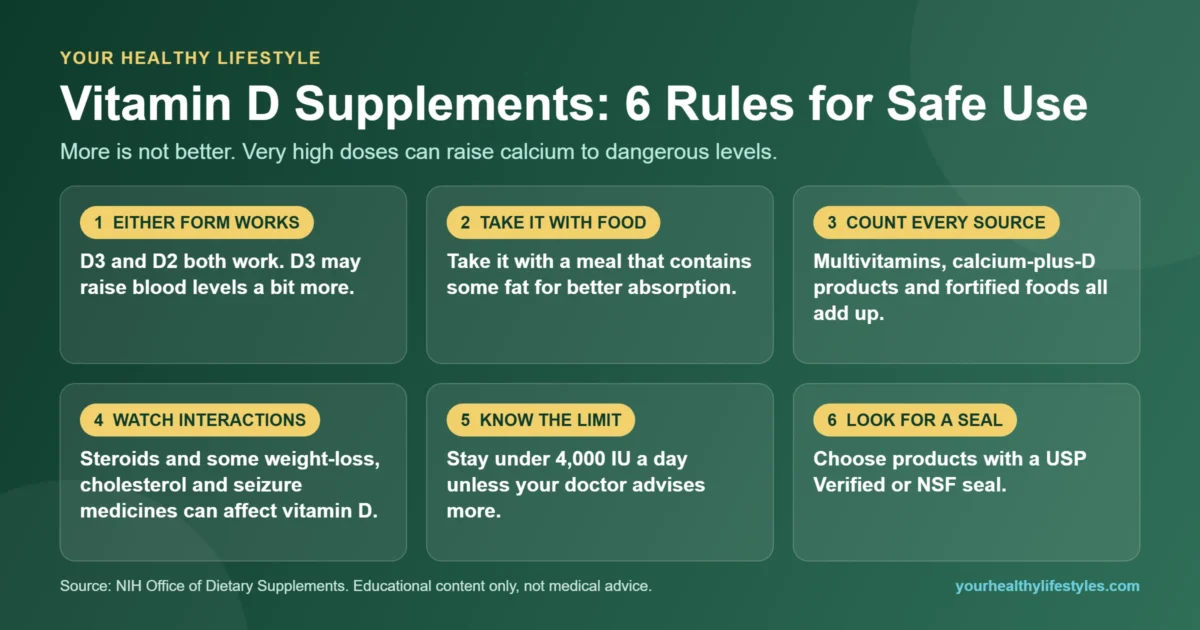
- Forms: D3 (cholecalciferol) and D2 (ergocalciferol) both work. D3 may raise blood levels a bit more.
- Take it with a meal that contains some fat for better absorption.
- Count every source: multivitamins, calcium-plus-D products and fortified foods all add up.
- Watch interactions: steroids, some weight-loss and cholesterol drugs, and certain seizure medicines can affect vitamin D. Thiazide diuretics combined with vitamin D can raise calcium.
- Too much can cause nausea, weakness, confusion, kidney stones and heart rhythm problems.
Choose products with a USP Verified or NSF seal. Our smart supplement guide explains what those seals mean.
Your next step
Add up the vitamin D in everything you take today, including your multivitamin. If the total is above 4,000 IU, or you are in a higher-risk group, bring your labels to your next doctor visit.
The bottom line
Most adults need 600 to 800 IU a day, food and sensible sun help, and supplements should stay under 4,000 IU unless your doctor says otherwise. Add up every source you take, including your multivitamin. Share this article with family members who may be at higher risk of low levels.
Frequently asked questions
Is it better to take vitamin D in the morning or at night?
Timing matters less than taking it with a meal that contains fat. Choose the time you will remember every day.
Should I take vitamin D with vitamin K2?
Some products combine them, but evidence for added benefit is limited. If you take warfarin, avoid vitamin K supplements unless your doctor approves.
How often should I test my vitamin D level?
Routine testing is not recommended for everyone. Your doctor may test if you have risk factors or are treating a deficiency.
Can I get enough vitamin D from food alone?
Many adults do not. Fatty fish, fortified milk and fortified cereals help, and short, sensible sun time adds more. If you still fall short, ask your doctor whether a supplement makes sense for you.
Who should read this article?
This article is for healthy adults who want the basics. If you are pregnant, take prescription drugs or have a chronic condition, ask your doctor what amount is right for you.
Related articles
Sources
About the author: Reginaldo Encarnacao is an independent health writer who researches public sources such as the National Institutes of Health (NIH). He is not a doctor, pharmacist or dietitian.
Medical disclaimer: The information on this page is for educational purposes only and is not intended to diagnose, treat, cure or prevent any disease. Statements about dietary supplements have not been evaluated by the Food and Drug Administration. Individual results vary. See our full disclaimer.